Intent vs. Interest: The One Filter That Separates a Lead from a Sale
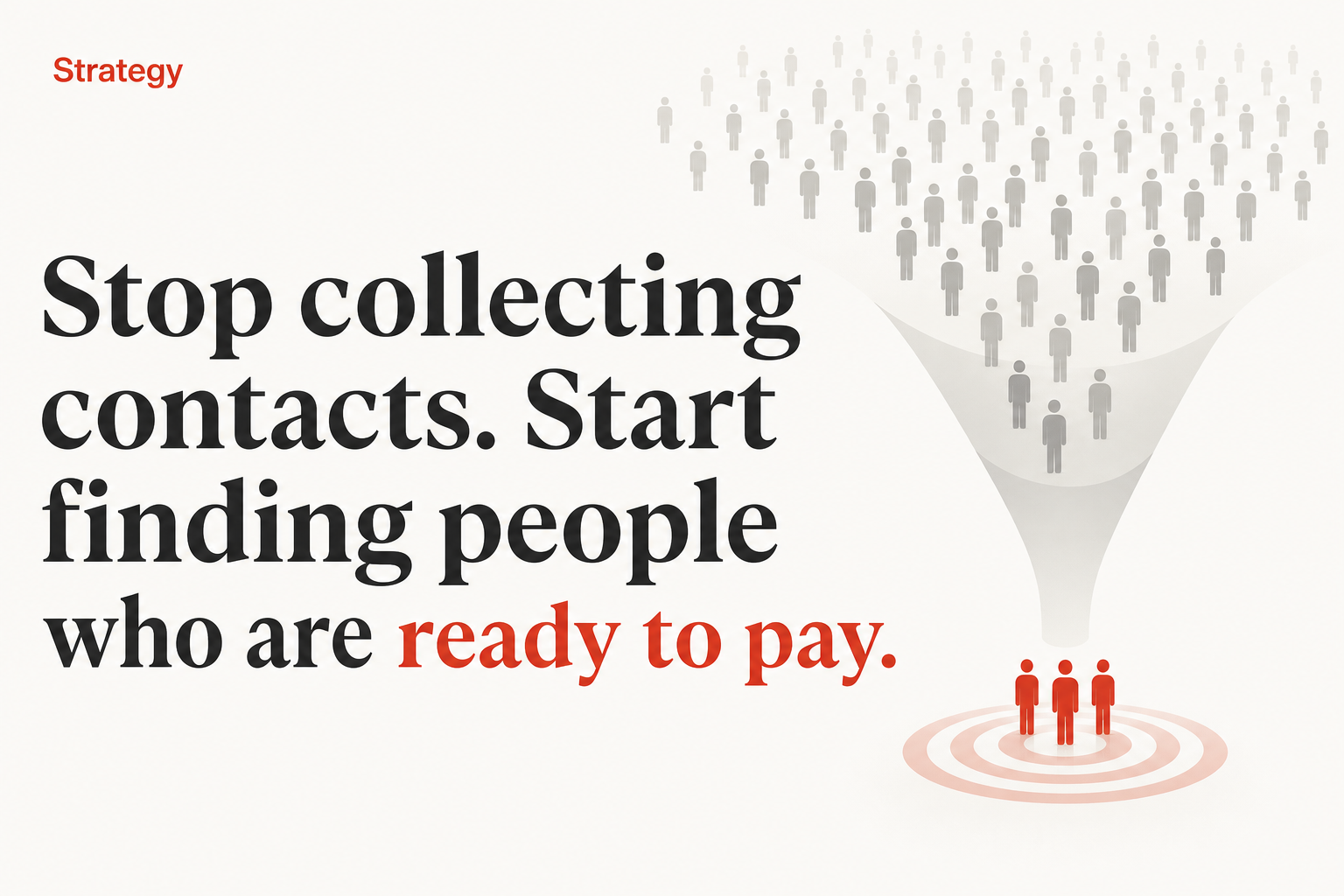
Stop collecting contacts. Start finding people who are ready to pay.
Your CRM is full. Open rates are decent. The pipeline looks healthy on paper. But close rates are mediocre and the sales cycle keeps stretching. You're doing more work per deal than you should be.
The most common diagnosis is "we need better leads." The real diagnosis is usually different: you're confusing interest with intent, and treating them the same way.
Interest is not intent
Interest means someone could theoretically benefit from your product:
- They follow you on LinkedIn
- They downloaded your whitepaper
- They clicked an ad
- They match your ICP — right company size, industry, tech stack
Interest is abundant and cheap to generate. It's also almost useless on its own.
Intent is different. Intent means someone has identified a specific problem and is actively looking for a solution right now. Not eventually. Not "when budget opens up." Now.
The difference in sales effort to close interest vs. intent is not linear — it's an order of magnitude.
Why we optimize for interest instead of intent
Because interest is easier to measure. Download numbers, open rates, click-throughs — clean metrics, clean dashboards. Intent is messier. It shows up in a Reddit thread, a LinkedIn comment, a Slack community message. It's distributed, qualitative, hard to attribute.
So most companies build their entire top-of-funnel around interest, and wonder why conversion rates are low. They've built a machine optimized for a metric that doesn't correlate with revenue.
The intent spectrum
Intent is not binary. Where a prospect sits on the spectrum should determine how you engage them:
Problem-aware — low intent
"Our reporting takes too long." They haven't decided they need a tool. Don't sell — educate. Be the resource they remember when they graduate to active evaluation.
Solution-aware — medium intent
They know tools exist. Reading comparison articles, asking peers. Make your product visible through content and community — be there when they're doing research.
Actively evaluating — high intent
Comparing specific tools, asking for demos, reading G2 reviews. Speed matters most here. The first vendor to respond helpfully often has a significant advantage.
Ready to switch — highest intent
Using a competitor and something went wrong — price increase, feature removed, support degraded. They've emotionally decided to leave. They just need somewhere to go. This is your highest-probability lead right now.

What to do with interest-based leads
Interest-based leads are not worthless — they just need a different strategy. The goal is to move them up the intent spectrum, not close them directly.
- Case studies that help them understand the cost of their problem
- Comparison pages that surface when they're researching alternatives
- Community presence that keeps you top of mind
- Retargeting that catches them when they graduate to active search
The mistake: treating interest-based leads with the same urgency as intent-based leads. Putting an SDR on every whitepaper download is burning capacity on the wrong thing.
Building an intent-first pipeline
An intent-first pipeline doesn't replace content marketing. It adds a fast lane for the prospects who are ready now.
The structure:
- Monitor where your buyers ask for help — communities, forums, Reddit, LinkedIn
- Filter for posts indicating active evaluation or readiness to switch
- Alert the right person immediately
- Respond personally within a few hours
- Track which conversations turn into pipeline
Companies that run both motions simultaneously — content engine for interest, monitoring system for intent — end up with pipelines that are both broad and efficient. They're not choosing between volume and quality. They're routing each type of lead to the right process.
The one filter
Before spending time on a lead, ask one question:
Has this person demonstrated that they are actively trying to solve a specific problem right now?
- Yes → prioritize immediately. These are your closes.
- No → nurture sequence. Wait for the signal.
It sounds obvious. Almost no one actually applies it.
TL;DR
- Interest = someone could benefit from your product. Cheap, abundant, hard to convert.
- Intent = someone is actively solving a problem right now. Rare, expensive to find, easy to close.
- Most companies optimize for interest metrics (downloads, opens) and wonder why close rates are low.
- The fix: route each lead type to the right process — don't treat them the same.
Find the people who are ready to buy right now
LeadScraper monitors Reddit around the clock and scores every post by purchase intent — so you always know which leads are worth your time.
See pricing →